China Top 10 Turret Milling Machine Manufacturers
Choosing a Turret Milling Machine involves more than comparing prices or reading a product brochure. Buyers should consider worktable size, spindle speed, available travel, control options, and the materials they plan to machine. These details affect whether a machine can handle a small repair shop’s daily tasks or a factory’s repeat production needs.
China has a broad milling-machine market, but manufacturers differ in product range, export experience, customization, and after-sales support. This guide introduces ten manufacturers for readers beginning that comparison. It is not a universal ranking: a suitable supplier depends on the work, budget, and local service requirements. That matters.
A compact workshop may value a straightforward manual model, while a production team may need digital readouts, stronger feed systems, or specific electrical configurations. Ask for current specifications, inspection records, warranty terms, and references for comparable installations. Photos can help, but they cannot confirm build quality on their own. Nor can a low quotation.
The companies discussed here provide a starting point, not a substitute for technical checks. Some details may be difficult to compare from public information alone. Buyers should confirm them directly before making a decision. A careful shortlist saves time—and can prevent an expensive mismatch.
Turret Milling Machine Basics: 3-Axis Motion, Spindle Taper, and Table Travel
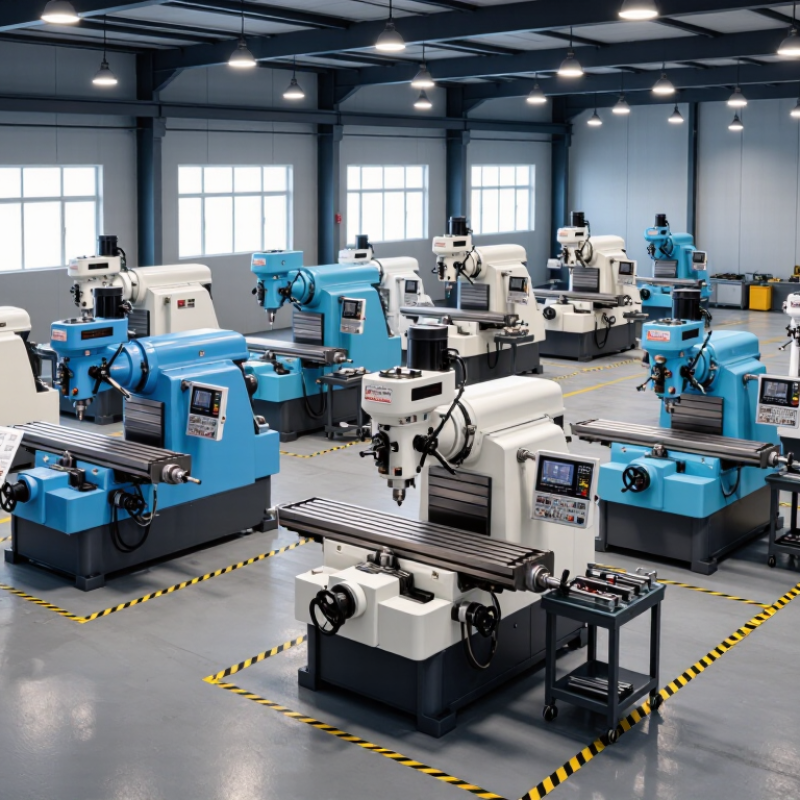
A turret milling machine moves the cutter across three axes: X, Y, and Z. X and Y usually come from table movement, while Z changes the cutter’s height. This arrangement suits slots, facing, and shallow pockets. Watch the setup, though. A vise, long cutter, or tall workpiece can limit usable movement before the machine reaches its stated maximum.
Spindle taper affects how the tool is held and what tooling fits. Common taper styles differ in size, retention method, and compatibility, so check the machine specifications before choosing holders. A clean, undamaged taper helps the holder seat properly. Small details matter. Chips on the contact surfaces can cause runout or vibration, even when the cutter looks secure.
Table travel describes how far the table can move along its axes; it is not the same as table size. Compare the listed travel with the part dimensions, vise footprint, and clearance needed for setup. A spec sheet can make this look simple; real setups are less tidy. Leave room for clamps and tool approaches, and remember that maximum travel may not be practical across the whole table. I might give travel too much attention, but cramped setups are frustrating.
China Top 10 Turret Milling Machine Manufacturers
Turret Milling Machine Basics: 3-Axis Motion, Spindle Taper, and Table Travel
The figures below are indicative ranges for common turret-milling-machine configurations, not specifications for particular manufacturers or models. Actual capacity and performance vary by machine design and manufacturer.
| No. |
Specification |
Typical range or options |
What to check |
| 1 |
3-axis motion |
X: table longitudinal; Y: saddle cross-feed; Z: knee vertical movement |
Confirm which axes have powered feed and whether the stated Z travel refers to knee travel, quill travel, or both. |
| 2 |
X-axis table travel |
Approximately 600–1,000 mm |
Choose travel based on workpiece length, fixture size, and required clearance at both ends. |
| 3 |
Y-axis table travel |
Approximately 250–400 mm |
Check available cross travel with the spindle head positioned for the intended operation. |
| 4 |
Knee Z-axis travel |
Approximately 350–500 mm |
Knee travel raises or lowers the table assembly; it is distinct from spindle quill movement. |
| 5 |
Spindle quill stroke |
Often approximately 100–150 mm |
Quill feed is useful for short vertical movements such as drilling and boring; it does not replace knee travel. |
| 6 |
Spindle taper |
Common options include R8, ISO 30, and ISO 40 |
Match the taper to available tooling and the machine’s intended cutting loads; these interfaces are not interchangeable without suitable tooling. |
| 7 |
Spindle speed |
Commonly about 60–4,500 rpm, depending on drive and configuration |
Check the available speed range and how it is selected; suitable speeds depend on cutter diameter, material, and operation. |
| 8 |
Table size |
Often approximately 1,000–1,400 mm long × 220–300 mm wide |
Compare usable table surface with the workpiece, vise, rotary table, and other fixtures. |
| 9 |
T-slots and table load |
Typically 3–5 slots; slot widths commonly around 14–18 mm; load capacity varies by machine |
Verify slot dimensions, spacing, and the rated table load before selecting fixtures or handling heavy workpieces. |
| 10 |
Main motor power |
Approximately 2.2–5.5 kW on many general-purpose configurations |
Compare power with the expected materials, cutter sizes, and cutting depth; also check the required electrical supply. |
Key Industry Metrics: X/Y/Z Travel, Spindle RPM, Motor kW, and Table Load
For China’s turret milling machine manufacturers, headline specifications are useful only when they describe the same configuration. X, Y, and Z travel determine the practical work envelope; check whether stated travel includes usable clearance around the spindle. A machine with 800 mm of X travel may still feel cramped when a large vise occupies the table. Measure your typical workpiece and fixture together.
Look beyond the maximum spindle speed. High RPM can help with small cutters, while lower speeds and adequate torque matter for larger tools. Motor power in kW should be compared with the duty cycle and spindle drive, not treated as a promise of constant cutting performance. Table load also needs context: include the vise, rotary fixture, and workpiece, then allow a sensible margin. Small detail, big difference. Ask whether the quoted capacity applies with the table centered or extended. Published figures can be inconsistent, and I would not rank suppliers from a single specification sheet. Request a test cut, operating notes, and confirmation of the exact machine configuration before comparing offers.
China Top 10 Turret Milling Machine Manufacturers
Key Industry Metrics: X/Y/Z Travel, Spindle RPM, Motor kW, and Table Load
Representative ranges from commonly published turret-mill specifications, shown without company or brand names and not as a manufacturer ranking. Bars show each range as a share of its metric’s reference ceiling; metrics use different units and are not directly comparable.
Typical ranges: X travel 600–1,000 mm; Y travel 300–400 mm; Z travel 350–500 mm; spindle speed 60–4,200 rpm; motor power 2.2–5.5 kW; table load 250–500 kg. Reference ceilings: 1,200 mm, 500 mm, 600 mm, 6,000 rpm, 7.5 kW, and 750 kg, respectively.
Accuracy Benchmarks: ISO 230-2:2014 Positioning Accuracy and Repeatability Tests
China Top 10 Turret Milling Machine Manufacturers
Accuracy Benchmarks: ISO 230-2:2014 Positioning Accuracy and Repeatability Tests
For a CNC turret milling machine, ISO 230-2:2014 provides a method for checking the positioning accuracy and repeatability of numerically controlled axes. Tests commonly examine X, Y, and Z movement at specified positions, including approaches from different directions. A calibrated laser interferometer or suitable linear measurement system can record deviations. The machine should be thermally stabilized, and test conditions should be documented. Small details matter: a warm axis, loose setup, or inconsistent approach can affect readings. ISO provides a test method, not one universal pass mark; compare results with the machine’s stated specifications and agreed acceptance criteria.
Tips: Keep the test setup consistent. Record axis direction, feed rate, ambient temperature, and measurement equipment. Repeat the test after any adjustment.
A strong report shows more than one impressive number. Review bidirectional positioning errors and repeatability across the full travel, not only near the center. For turret mills, axis results do not automatically describe spindle behavior, tool changes, or cutting performance. Those need separate checks. Still, one tidy report can feel more convincing than it should; real shop conditions may reveal errors that a controlled test does not.
China’s Top 10 Turret Milling Machine Manufacturers Compared by Published Specs
A useful comparison of China’s ten leading turret milling machine manufacturers should begin with verifiable published specifications, not ranking claims.
Record table travel, working-surface dimensions, spindle-speed range, motor power, taper, and stated positioning accuracy. These figures reveal practical differences: a longer X-axis travel may suit larger fixtures, while a broad speed range supports varied cutter sizes. Check whether each figure applies to the standard machine or an optional configuration.
Small print matters.
The International Federation of Robotics reported
541,302 industrial robots installed worldwide in 2023
(World Robotics 2024), underscoring demand for consistent, automation-ready production. That figure is not a milling-machine sales statistic, so it should not be treated as one. For accuracy claims, ISO 230-2 provides a method for testing numerically controlled machine-tool positioning accuracy and repeatability. Published brochures rarely show comparable test conditions, thermal state, or measurement setup.
A neat specification table can therefore overstate certainty.
Compare like with like, request test reports, and verify spindle power across the stated speed range. I would also flag missing data rather than fill gaps with assumptions; that makes the ranking less tidy, but more useful to buyers.
How to Verify Quality: Test Reports, Production Capacity, and Export Records
For a shortlist of China’s ten turret milling machine manufacturers, request a machine-specific test report, not a generic certificate. ISO 230-1:2012 describes tests for machine-tool geometric accuracy, while ISO 230-2:2014 covers positioning accuracy and repeatability of numerically controlled axes. Check that reports name the exact model and serial number, test conditions, instruments, and calibration dates. Compare spindle runout, table travel, and backlash readings with the supplier’s stated tolerances. Ask whether measurements were taken both before and after warm-up. Small details matter. A polished PDF alone proves little.
Verify production capacity through observable records: assembly schedules, inspection logs, workforce levels, and quoted lead times. A claimed monthly output should match the factory’s actual assembly space and completed-machine records. For export history, compare redacted shipping documents with annual trade data in the UN Comtrade database, using the relevant product classification. Check whether shipment dates, destination markets, and product descriptions remain consistent over time. Trade statistics show movement, not machine quality, and customs classifications can group different equipment together. Treat gaps as questions, not automatic disqualifiers. I would still request a live video of the machine cutting material, with the model plate and test setup visible.